
IMMERSIVE SPATIAL SOUND
AUDIO DRAMA | MUSIC PRODUCTION | THEATRE | concerts | CINEMA | VR, AR, MR, AND XR
A Guide to Creating 3D Sound in Live, Recorded and Digital Environments
IMMERSIVE SPATIAL SOUND offers clear, practical advice on how to master the tools and techniques for creating 3D sound in your live and recorded work. Written for sound designers and audio professionals in all industries, this guide demystifies the concepts behind spatial audio, from binaural and ambisonics to Dolby Atmos and object-based sound. Real-world case studies highlight the challenges, technologies and creative strategies used by leading practitioners. Packed with expert tips, troubleshooting insights and industry-tested workflows, Immersive Spatial Sound is the go-to reference for bringing depth, direction and drama to every sound you create.
INSIDE, YOU'LL FIND:
Step-by-step techniques for recording, editing and mixing immersive audio
Deep dives into the spatial tools used in theatre, live events, audio drama, cinema, and music production
A breakdown of VR, AR, MR, and XR audio workflows
Tips on interactivity, listener perspective, and spatial realism
Case studies from high-profile projects, revealing the problems encountered and creative solutions
A new book coming in May 2026, published by Crowood Press
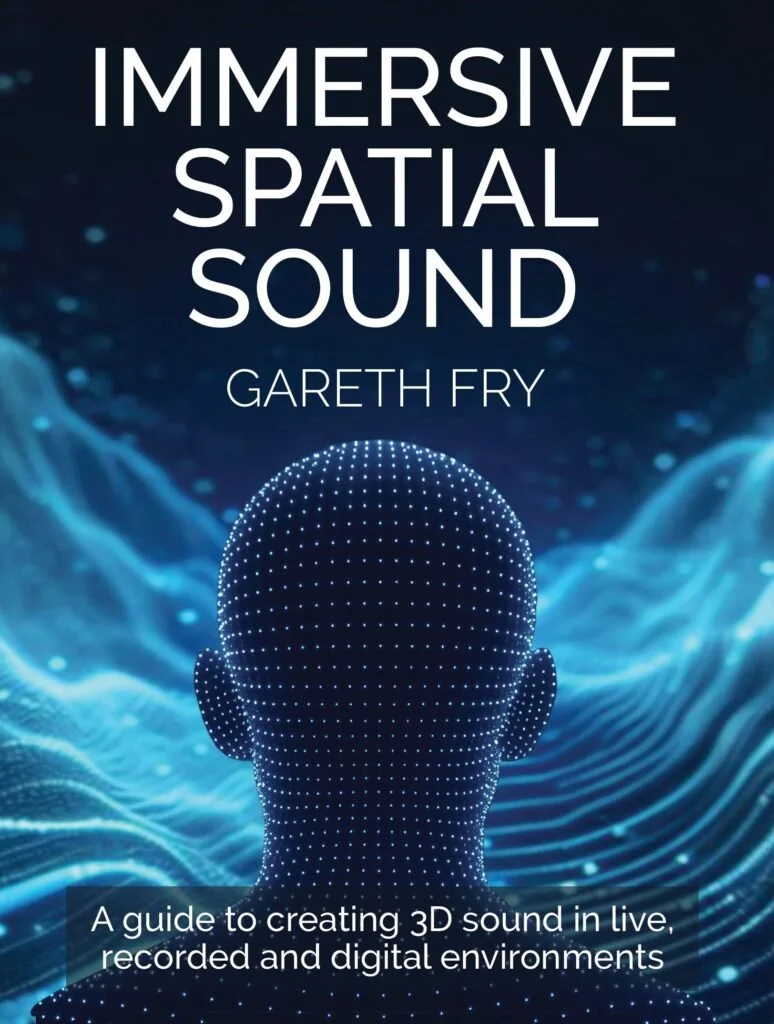
-
INTRODUCTION
1 - HOW WE CREATE A 3D SOUNDSCAPE OF THE WORLD
DIRECTION OF SOUND
HORIZONTAL RESOLUTION
VERTICAL RESOLUTION
FREQUENCY
DISTANCE PERCEPTION
THE SPACE IN SPATIAL SOUND
CONSCIOUSNESS
AUDITORY SCENE ANALYSIS
WHAT WE PAY ATTENTION TO
WHAT WE IGNORE
WHAT IS IMPORTANT TO LISTEN TO?
OBJECTIVITY AND UNIVERSALITY
HEAD BOBBING
MOVEMENT
SELECTIVE ATTENTION
MULTIMODAL PERCEPTION
2 - BINAURAL SOUND
BUT WHY?
MICROPHONE DIRECTIVITY
CONVENTIONAL STEREO RECORDING
THE AB STEREO TECHNIQUE
THE XY STEREO TECHNIQUE
THE ORTF STEREO TECHNIQUE
THE MID-SIDE (MS) TECHNIQUE
BINAURAL RECORDING
USE YOUR HEAD
DIY HEAD
MINI BINAURAL HEADS
FULL-SIZE BINAURAL HEADS
WHAT'S THE CATCH?
NOISE AND ACOUSTICS
BINAURAL PANNERS
WHAT DO I NEED TO START PLAYING WITH BINAURAL SOUND?
ASMR
BINAURAL BEATS
3 - USING BINAURAL SOUND IN AUDIO DRAMA
DRAMATIC POSSIBILITIES & PRACTICAL CONSIDERATIONS
THE CONVENTIONAL PROCESS OF AUDIO DRAMA PRODUCTION
HEAR, DON’T TELL - WRITING FOR SPATIAL AUDIO
PERSPECTIVE, PRESENCE AND INTERACTIVITY
THE DISCOVERY ADVENTURES
THE DARK IS RISING
SCRIPT CHOICES
TELL WHEN YOU CAN’T SHOW
RECORDING BINAURAL AUDIO
RECORDING ON LOCATION
SIGNAL VS NOISE
STUDIO RECORDING
JOURNEYS AND GEOGRAPHY
BINAURAL EDITING
MUSIC
PRODUCTION ELEMENTS
SFX
LIBRARY & RECORDED & SYNTHESISED SFX
FOLEY SFX
MIX, MASTER AND DELIVERY
DOLBY ATMOS FOR AUDIO DRAMA
4 - USING BINAURAL SOUND IN THEATRE
THE ENCOUNTER
MACBETH
LEFT-CENTRE-RIGHT
LOGISTICS
BRING YOUR OWN DEVICE (BYOD)
WIRELESS HEADPHONES
WIRED HEADPHONES
VOLUME CONTROL
BRING YOUR OWN HEADPHONES (BYOH)
MAKING A WIRELESS SYSTEM WORK
USING WIRELESS AS A BACKUP SYSTEM
PRE-SHOW CHECKS
ACCESSIBILITY
HEADPHONE TYPES
ON-EAR HEADPHONES
OVER-EAR HEADPHONES
IN-EAR HEADPHONES
BONE CONDUCTION HEADPHONES
OPEN BACK VS CLOSED BACK
NOISE REDUCTION AND TRANSPARENCY
5 - AMBISONICS, DYNAMIC BINAURAL SOUND AND 360° FILMS
MOVING BEYOND THE FIXED PERSPECTIVE OF BINAURAL
360° FILMS
AMBISONICS
OTHER SOUND FIELD RECORDING TECHNIQUES
AMBISONIC TO BINAURAL SOUND
DYNAMIC BINAURAL SOUND
SIMULATIONS OF OTHER MICROPHONE TYPES AND FORMATS
AMBISONICS FOR INTERVIEWS
AMBISONIC PANNERS
SPAT, NON-SPAT AND HEAD-LOCKED STEREO
THE DECLINE OF 360° VIDEO
AMBISONICS AND SPEAKERS
IN CONCLUSION
WHAT DO I NEED TO START EXPERIMENTING WITH AMBISONIC SOUND?
6 - VR, AR, MR AND GAME AUDIO TECHNOLOGY
WHAT’S THE DIFFERENCE BETWEEN VR, AR, MR AND XR?
THE GAME ENGINE
TIMELINES VS INTERACTIVITY
IN PURSUIT OF REPETITIVE BEATS
VR vs MR
REKORDER-LAND
WHAT DO I NEED TO START PLAYING WITH VR & AR?
HAPTICS
7 - LOUDSPEAKER SPATIALISATION
GLORIOUS MONO
STEREO
QUADROPHONICS
THE LOUDSPEAKER SIDE OF THINGS
COMMON LOUDSPEAKER SYSTEMS
AT HOME
DEATH TO THE SMART SPEAKER, LONG LIVE THE HI-FI
IN THE CAR
UPMIXING
AMBISONICS AND SPEAKERS
8 - CINEMA, HOME CINEMA AND THE RISE OF DOLBY ATMOS
CINEMA
7.1
DOLBY ATMOS
OBJECTS AND BEDS
HOW WE USE SURROUND SOUND
WHY ISN’T DIALOGUE RECORDED WITH AN AMBISONIC OR BINAURAL MIC?
DOLBY ATMOS HOME ENTERTAINMENT - HOME CINEMA & TV
BEYOND CINEMA
WHAT DO I NEED TO START PLAYING WITH DOLBY ATMOS?
IMAX
DTS:X
THX
DVD & BLU-RAY
9 - SPATIAL AUDIO FOR MUSIC PRODUCTION
SPATIAL SOUND FOR THE RECREATION OF THE PLAYING ENVIRONMENT
SPATIAL SOUND FOR THE MODERN AESTHETIC OF MIXING MUSIC
REMASTERING EXISTING ALBUMS IN SPATIAL SOUND
CREATING A NEW AESTHETIC IN SPATIAL SOUND
8D AUDIO
STEREO VS SPATIAL MUSIC PRODUCTION - RECORD, EDIT, MIX, MASTER
RECORDING FOR SPATIAL MUSIC
MIXING ON SPEAKERS VS HEADPHONES
BINAURAL RENDER MODE
PANNER PAN LAW CONFUSION
WHAT CAN WE TAKE AWAY FROM THIS CONFUSING SET OF IMAGES?
SPATIALISING
EFFECTS
DYNAMICS
LFE
MASTER
TESTING
DISTRIBUTION - DD+ JOC AND AC4-IMS - AKA MORE TECHNICAL MALARKEY
LOUDNESS
WHAT DO I NEED TO START PLAYING WITH DOLBY ATMOS?
10 - THEATRE AND CONCERTS
THEATRE
SURROUND SOUND
CONCERTS
SURROUND SOUND
EXIT NON-SPATIAL AUDIO, PURSUED BY A BEAR
SPATIALISED REVERB & VIRTUAL ACOUSTICS
LOCALISING PERFORMERS
LOCALISING MUSIC
BRING ME ALL THE SPEAKERS
HAMLET HAIL TO THE THIEF
HARRY POTTER AND THE CURSED CHILD
WAVE FIELD SYNTHESIS
FILTERING THE TRACKING SYSTEM
SPATIALISATION SYSTEMS
WHAT DO I NEED TO START PLAYING?
11 - THE FUTURE
ERRORS AND CORRECTIONS
On page 98 and page 142 some QR codes have been incorrectly placed, which don’t have corresponding audio examples on this website.
If you spot any other errors, please let me know.
ADDItIONAL RESOURCES AND AUDIO EXAMPLES
The book contains QR codes that link to specific chapters containing audio and video examples of the concepts discussed. Some additional resources are below.
Comparing the spatial resolution of different systems
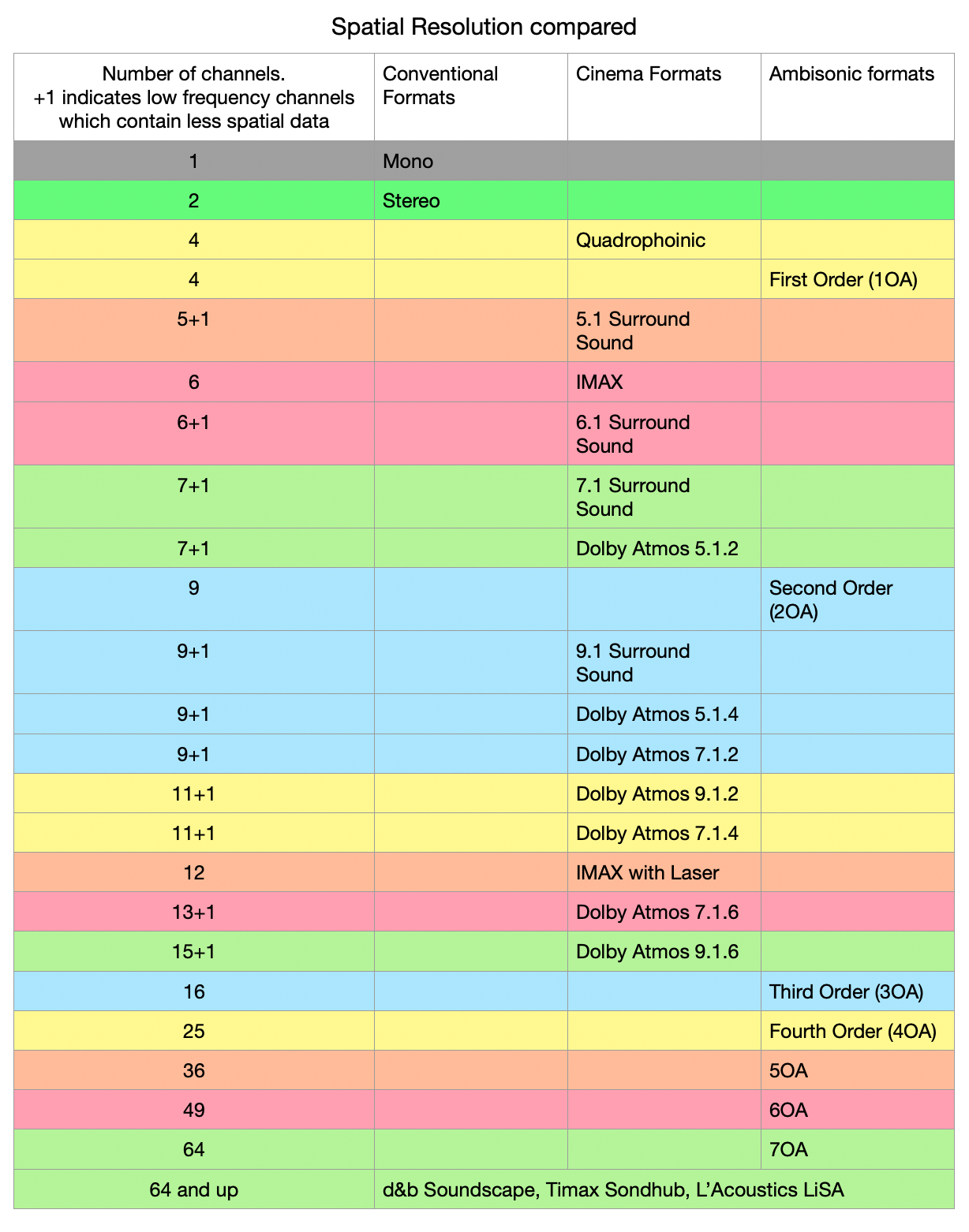
Note, number of channels does not equate to number of loudspeakers.: many systems drive multiple loudspeakers from one channel. Ambisonic systems have a different correlation between channels and loudspeakers where, for example, a first order ambisonic loudspeaker uses 4 channels of sound but would typically use 8 individually amplified loudspeakers for playback.
The higher the spatial resolution the more accurately a system can place a point source sound in space around us, albeit subject to many caveats.
Binaural sound over headphones isn’t mentioned in this chart, although it can create results that seem to compare with Fifth Order ambisonics, though this will vary from individual to individual.