
CHAPTER THREE - BINAURAL SOUND IN AUDIO DRAMA
This page contains examples for the book Immersive Spatial Sound.
Chapter 1 - How We Create A 3D Soundscape Of The World | Chapter 2 - Binaural Sound | Chapter 3 - Using Binaural Sound In Audio Drama | Chapter 4 - Using Binaural Sound In Theatre | Chapter 5 - Ambisonics, Dynamic Binaural Sound & 360° Films | Chapter 6 - VR, AR, MR & Game Audio Technology | Chapter 7 - Loudspeaker Spatialisation | Chapter 8 - Cinema, Home Cinema & The Rise Of Dolby Atmos | Chapter 9 - Spatial Audio For Music Production | Chapter 10 - Theatre & Concerts
Please wear headphones when listening to these examples.
Before you start listening to examples, check your headphones are working properly by playing this audio clip.
-
There is a little known issue with Bluetooth headphones/headsets. If you are using a set of wireless/Bluetooth headphones, and you select to also use that as the microphone in your teleconferencing software (Zoom, Meet, Teams, Skype, etc) then all audio in your headphones will change from stereo to mono, and is reduced to a really low quality 8kHz sample rate. This is because the Bluetooth data bandwidth is quite low, so if you’re not using the mic built in to your headphones, all that data can be used to provide high quality stereo audio; but if you use the mic, half that data is used for the microphone, and only half the data is then available for the headphone audio. This is a feature of Bluetooth itself, so this applies to Mac’s and PC;s, desktops and tablets, cheap Bluetooth headphones and the most expensive Apple headsets.
You can test this:
connect some bluetooth headphones to your computer.
close all applications.
listen to this track: https://www.youtube.com/watch?v=VnzIIhLNHqg
it should sound super high quality, very stereo and lovely.
Now, open up Zoom or Meet or Teams, and start a new meeting, with the Mic input set to your bluetooth headphones
You should instantly hear the audio in your headphones flatten into mono, and reduce in audio quality to about 10% of what it was.
You can get round this by using wired headphones, Bluetooth headphones that don’t have a built-in mic (quite rare these days) or by using your Bluetooth headphones and selecting to use the build-in computer microphone rather than the headphones’s microphone.
And yes, it does apply to AirPods too.
PAGE 41 - worldizing sound
PAGE 42 - SWITCHING BETWEEN Mono AND binaural sound TO CONTRAST INTERNAL NARRATIVE VS EXTERNAL ENVIRONMENT
This ie a demo of a character’s internal voice vs their external voice. Sorry, this is terrible scriptwriting and acting from me.
PAGE 44 - INBETWEEN VS Triangle blocking
The binaural head is placed in a triangle blocking arrangement with the two performers.
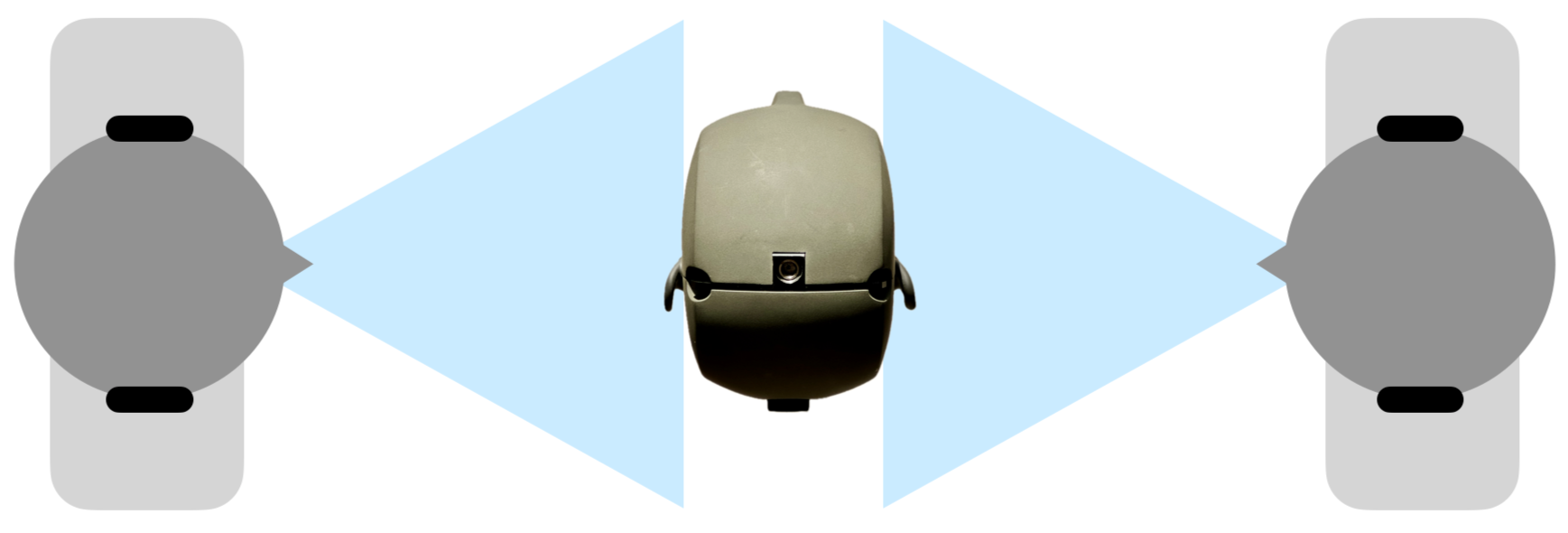
When the binaural head is positioned between two people having a conversation, and the two people only address each other, it feels like we are an invisible voyeur in the situation.
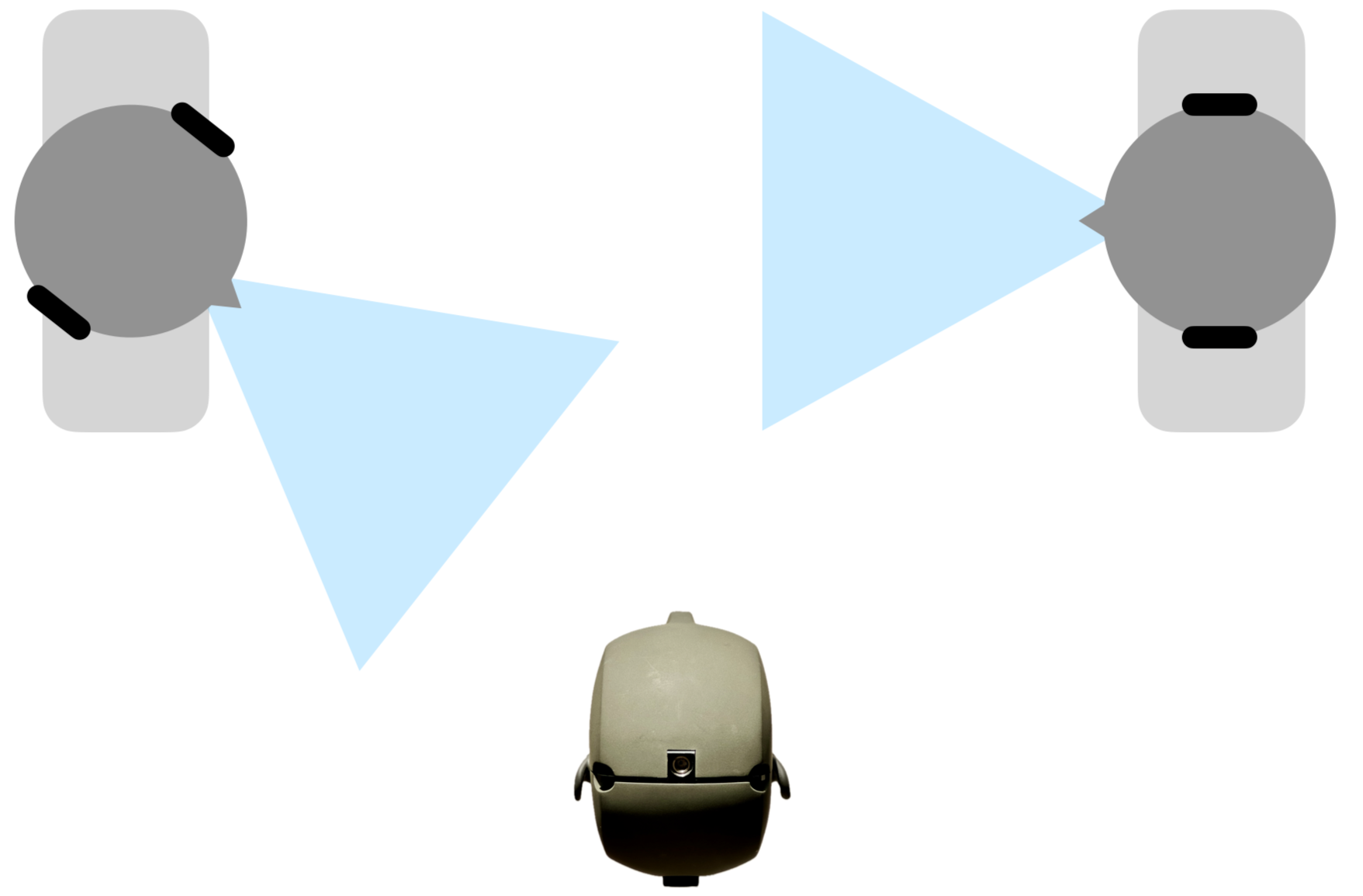
When the binaural head is positioned in a triangle with the two people haaving a conversation, and the two people swap between addressing each other, and addressing the binaural head, it feels like we are an present in the situation.
PAGE 46 - SIGNAL VS NOISE ON Binaural vs directional MICS
This video shows some of the difficulties of recording on location in a noisy environment with a binaural microphone. As the thing you want to record gets further away from the microphone, it can become enveloped by the environment a lot more quickly than with a directional microphone. Of course, this is entirely subjective, and that might be exactly the effect you are trying to achieve!
PAGE 49 - Listen to the different layers of The Discovery Adventures
FOLEY CUE SHEET
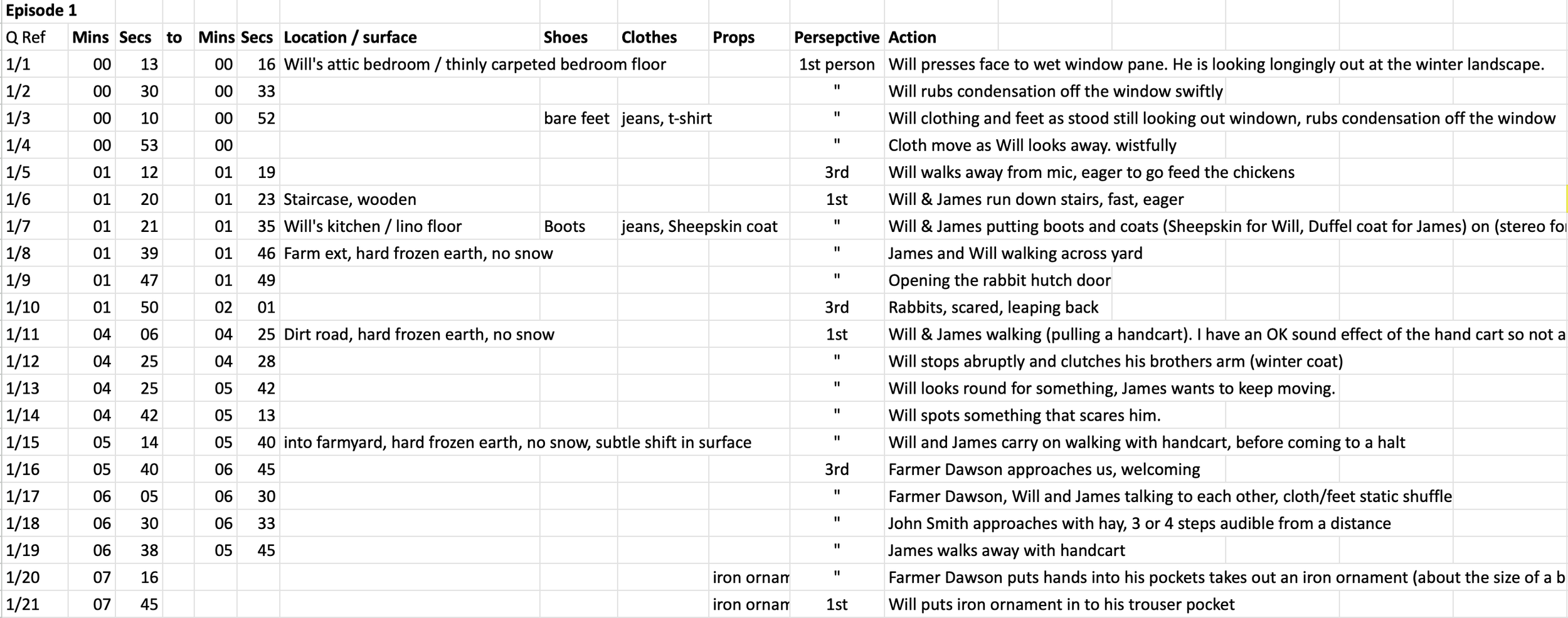
PAGE 53 - MASTERING AT BROADCAST (-23LUFS) VS PODCAST LEVELS (-14LUFS)
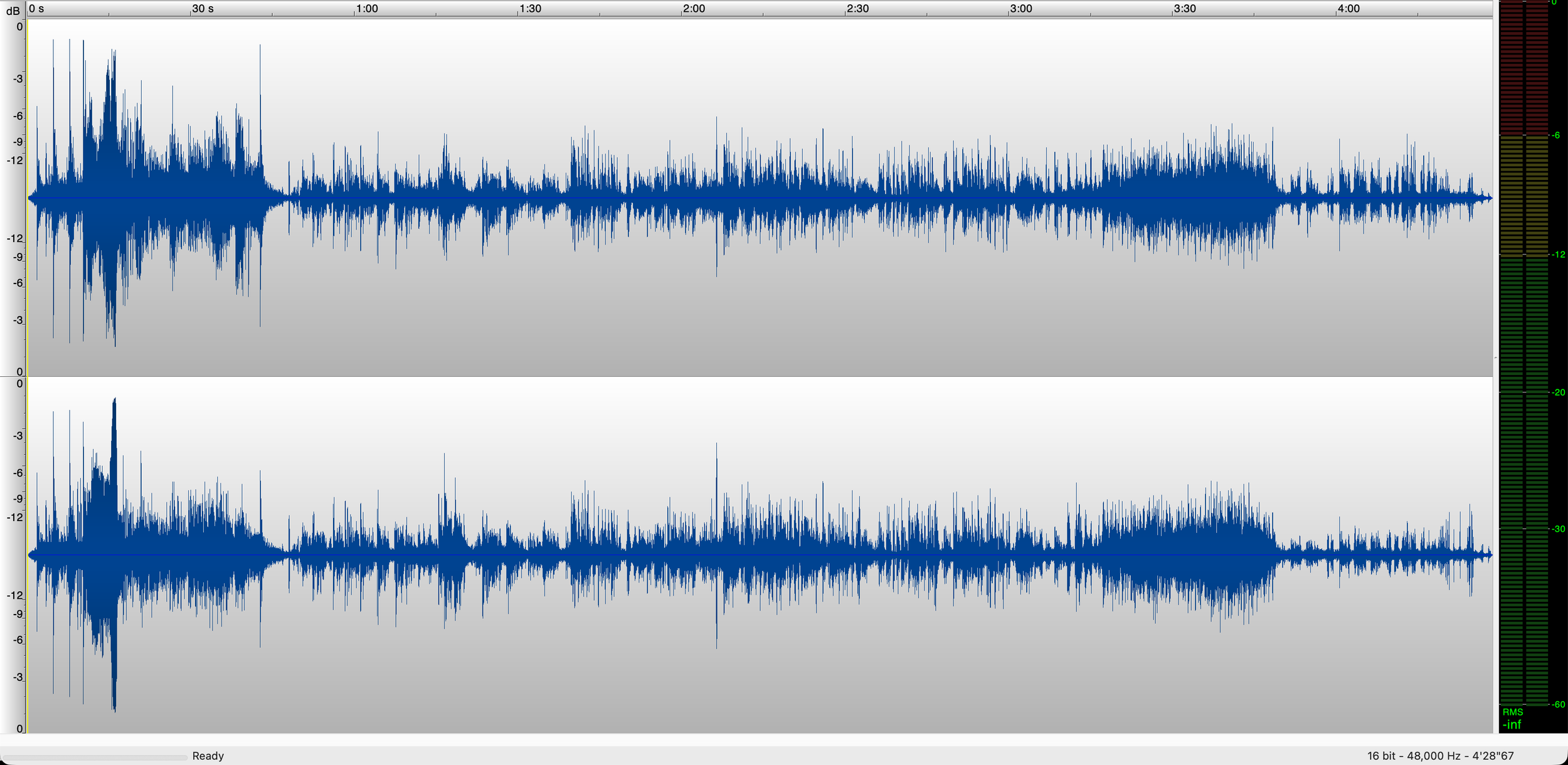
An action sequence followed by a dialogue sequence, mastered at -23LUFS (though this section is at -21LUFS). Notice that the action sequence is noticably louder than the quieter dialogue section.
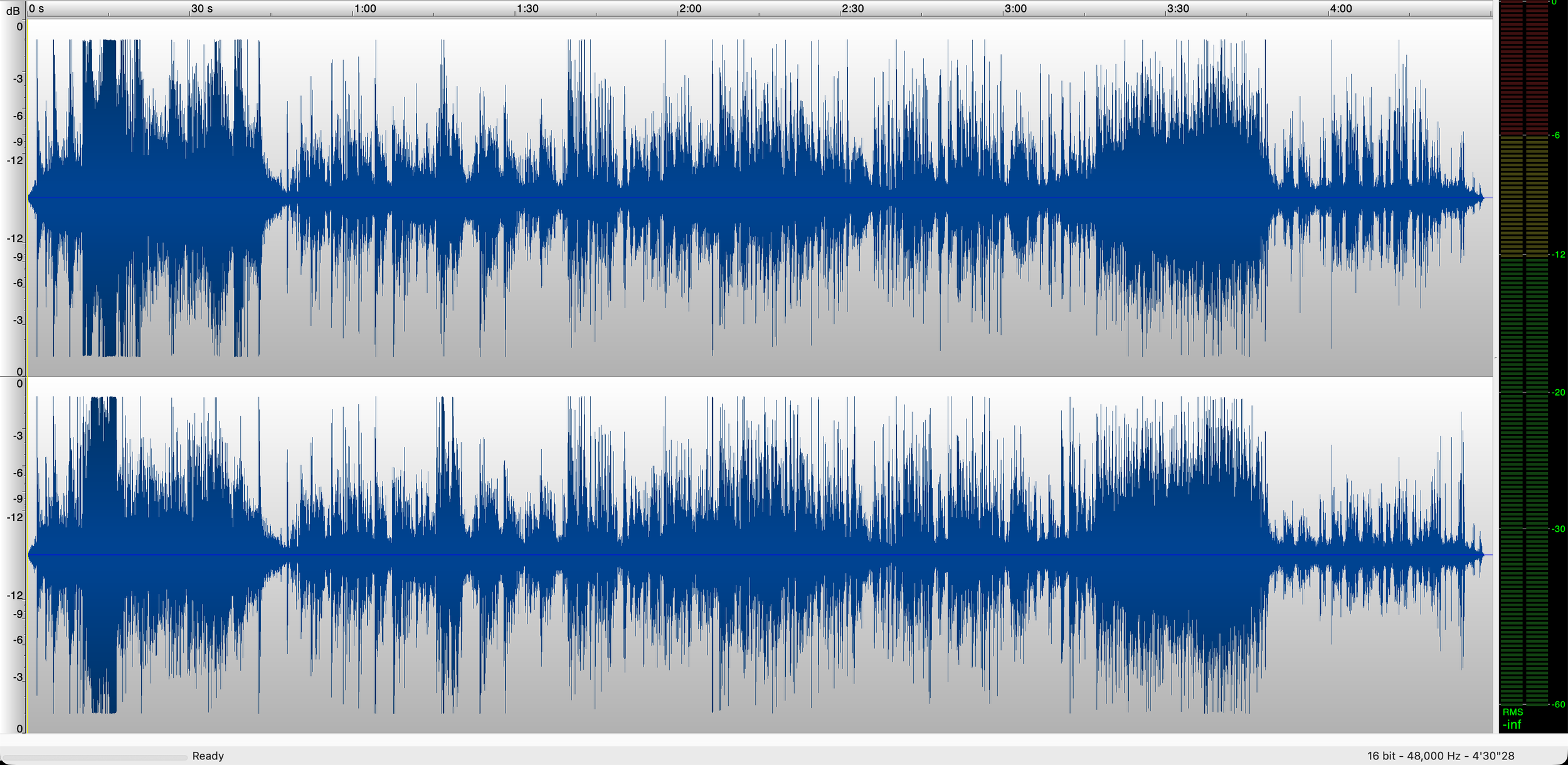
An action sequence followed by a dialogue sequence, mastered at -14LUFS. Notice how the loud section is more compressed, and the quiet section of dialogue has to be made louder to achieve the -14LUFS specification. Mastering at -14LUFS means you have less dynamic range to utilise.
PAGE 53 - Adding panned radio mics to a binaural stereo recording
PAGE 54 - WHAT HAPPENS WHEN BINUARAL IS HEARD IN MONO
A great BTS video looking at the making of the full cast audiobook of the Harry Potter series